
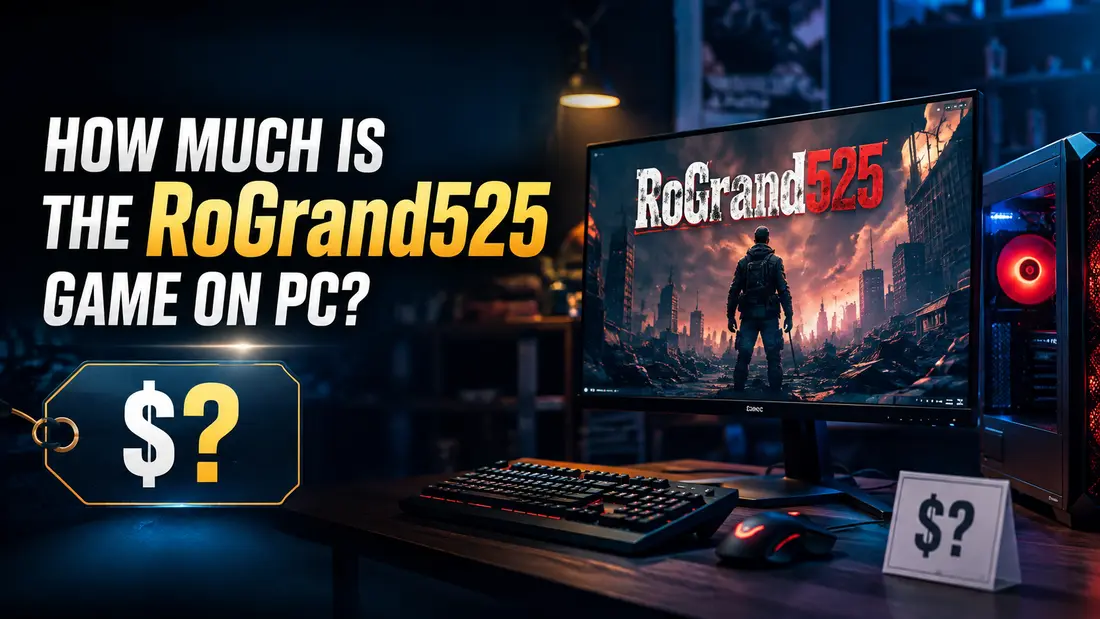
You typed in “how much is the RoGrand525 game on PC,” expecting a quick number. Instead, you probably got five different answers. One site says $29.99. Another says $69.99. A third throws out a range as wide as $19.99 to $89.99. That is not normal for a real, actively sold PC game.
So we did what most of those sites did not: we actually checked. We looked for an official storefront listing, a real publisher, and any confirmation that RoGrand525 exists as a purchasable PC title. What we found explains why the pricing is such a mess, and it will help you spot this exact problem the next time it happens with a different game name.
This kind of confusion is more common than most people realize. New game names, obscure indie titles, and search terms with numbers or unusual spelling attract exactly this type of scattered, low quality content. Once you know what to look for, spotting it takes seconds instead of an afternoon of clicking through contradictory blog posts.
In this guide, you will see exactly what people are finding when they search this term, why no one can agree on a price, and how to verify any game’s real cost before you trust a random article.
What People Are Actually Finding When They Search This
Search “RoGrand525 price” right now and you will land on a handful of blog posts that all claim to have the answer. They just do not agree with each other.
One article lists the standard edition at $29.99 with a $49.99 special edition, and mentions seasonal drops as low as $19.99. Another quotes $29.99 for the base game but $44.99 for the deluxe version, and compares it to other indie survival titles. A third source skips both of those numbers entirely and claims the standard edition costs $69.99, with a deluxe edition at $89.99. A fourth lands somewhere in the middle, putting the standard edition between $30 and $40.
If you lined these numbers up on a chart, they would not even overlap cleanly. That alone should raise a flag. Real games have one official price per edition, set by the publisher, and it does not swing by sixty dollars depending on which blog you happen to click.
Think about how pricing actually works for games you already know exist. A title like Hollow Knight or Hades has the same base price everywhere you look, whether you check the Steam page, a review site, or a retailer roundup. Regional pricing and sales create small variations, but the core number holds steady because there is one publisher setting it. RoGrand525 does not behave that way. The numbers do not just vary slightly, they contradict each other outright, which points to guesswork rather than regional pricing quirks.
The Bigger Inconsistency
The pricing disagreement is not even the strangest part. Dig a little further and you will find pages that do not describe RoGrand525 as a game at all. One “complete guide” describes it as a PC launcher, similar to Steam or GOG, that organizes your existing game library. Another describes it as a gaming console you unbox, with up to 1TB of storage. A few others describe RoGrand525 as a gaming content creator and streamer known for a mix of skill and humor.
A game, a launcher, a console, and a person are four very different things. When search results cannot even agree on what category RoGrand525 belongs to, that is a much bigger red flag than any single price tag.
Why Couldn’t We Confirm an Official Price?
Here is the short answer: there is not one to confirm.
No Listing on Steam, Epic, or GOG
A real PC game, even a small indie one, shows up on at least one major storefront. Steam alone lists tens of thousands of titles, and a game does not need a big budget to get a store page. RoGrand525 does not appear as a game on Steam, Epic Games Store, or GOG under that name.
No Identifiable Publisher or Developer
Every legitimate game has someone behind it. A studio name, a publisher, a press release, an announcement trailer, something. None of the articles claiming to sell you RoGrand525 name a developer or publisher. They describe gameplay in vague, generic terms, “vibrant graphics,” “intricate gameplay mechanics,” “immersive gameplay,” without ever pointing to a source you could verify.
What That Combination Usually Means
No storefront listing plus no named developer is a pattern worth recognizing. It usually means one of two things: either the name is being used to describe something else entirely (a launcher, a creator, a console, as we saw above), or the “game” itself was invented, likely by content written to rank for a search term rather than to describe a real product.
How Did So Many Pages End Up With a Price, Then?
This is the part that actually matters for you as a reader. If RoGrand525 is not a confirmed game, why do multiple websites confidently quote a price for it?
The most likely explanation is a feedback loop of low quality, AI-assisted content. When a search term starts getting traffic, whether from curiosity, a misheard name, or an algorithm quirk, content sites can rush to publish an answer, even without a verified source. Some of that content appears to be generated with minimal fact checking, filling in plausible-sounding numbers ($29.99 is a very common indie game price point) because it fits the shape of the question, not because it reflects a real listing.
Once one page publishes a price, later pages searching the same term find that number and repeat it, sometimes with small variations. Add a few sites making up their own numbers independently, and you end up with exactly what we found: a cluster of confident-sounding articles that all disagree with each other and none of which link back to an actual storefront page.
This is not unique to RoGrand525. It happens with obscure app names, supplement brands, and niche products across the web. The pattern is always the same: high confidence, low verifiability.
How to Verify a Game’s Real Price Before You Trust Any Article
You do not need to be a tech expert to catch this. A few quick checks will tell you whether a game is real before you trust anyone’s price quote, including ours. The same instincts apply well beyond gaming too. If you spend time researching products, tools, or trends online, it is worth building a habit of checking sources rather than taking the first confident answer at face value. We cover more of that mindset across our blog, if you want to dig deeper into spotting low quality content in general.
Check the Official Storefront Directly
Skip the blog posts and go straight to Steam, Epic Games Store, or GOG. Search the exact name. If the game exists and is for sale, it will show up with an official price, screenshots, and a store description written by the publisher. If it does not show up at all, that alone tells you most of what you need to know.
Look for a Named Developer or Publisher
A real game has a studio behind it. Search the developer or publisher name separately. You should find a website, other released titles, or at minimum a social media presence tied to actual game development, not just marketing content.
Cross Check the Release Date and Screenshots
Vague claims about “beautiful graphics” and “immersive gameplay” mean nothing on their own. Look for an actual release date, and check whether the screenshots being used across different articles are consistent, or whether they are stock images, AI generated art, or missing entirely.
Be Wary When Every Article Uses Near Identical Phrasing
If five different sites all describe a game using the exact same generic phrases, “engaging storyline,” “dynamic graphics,” “captivates players,” with no specific details that could only come from actually playing it, that is a strong sign the content was mass produced rather than written by someone with hands on experience.
What to Do If You Can’t Find a Game You’re Looking For
Sometimes the game you are searching for is real, and you are just not finding it because of a naming issue. Before assuming it does not exist, try a few things.
Search Variant Spellings
Names get mangled easily, especially ones with numbers or unusual capitalization. Try RoGrand525, Rogrand525, Ro Grand 525, and any other reasonable variation. A single letter difference can be the reason a storefront search comes up empty.
Check if the Name Matches Something Else
As we saw here, the same name can be attached to a launcher, a console, or a streamer’s handle. If your searches keep returning content about software or a person rather than a purchasable game, you may be looking at the wrong category entirely, not a hidden game.
When to Just Assume It Doesn’t Exist
If you have checked the major storefronts directly, searched for a developer, and tried spelling variations, and you still find nothing but vague blog posts with disagreeing prices, it is reasonable to conclude the game either is not real, is not yet released, or does not exist under the name you searched. Trust the absence of verifiable evidence over the presence of confident sounding articles.
Conclusion / Final Thoughts
There is no verifiable price for the RoGrand525 game on PC, because there is no verifiable RoGrand525 game on PC. No listing on Steam, Epic, or GOG, and no named developer behind it, are the two clearest signs of that.
The disagreement across articles is not just noise, it is the actual answer. When multiple sources confidently quote different prices for the same product with no shared source, that inconsistency is more informative than any single number they give you.
Next time you search for a game’s price and the results feel off, run the same thirty second check we did here: go straight to the storefront, look for a real developer, and treat identical, generic phrasing across multiple sites as a warning sign rather than confirmation.
We built this breakdown the same way we approach everything, by checking the primary source first and only publishing what actually holds up. If you have run into a similarly confusing “phantom” game search yourself, we would love to hear about it. And if RoGrand525 ever does get an official release with a confirmed price, we will update this page to reflect it.
Read Also: Is 2579xao6 Easy to Learn? Here’s Why That’s the Wrong Question