

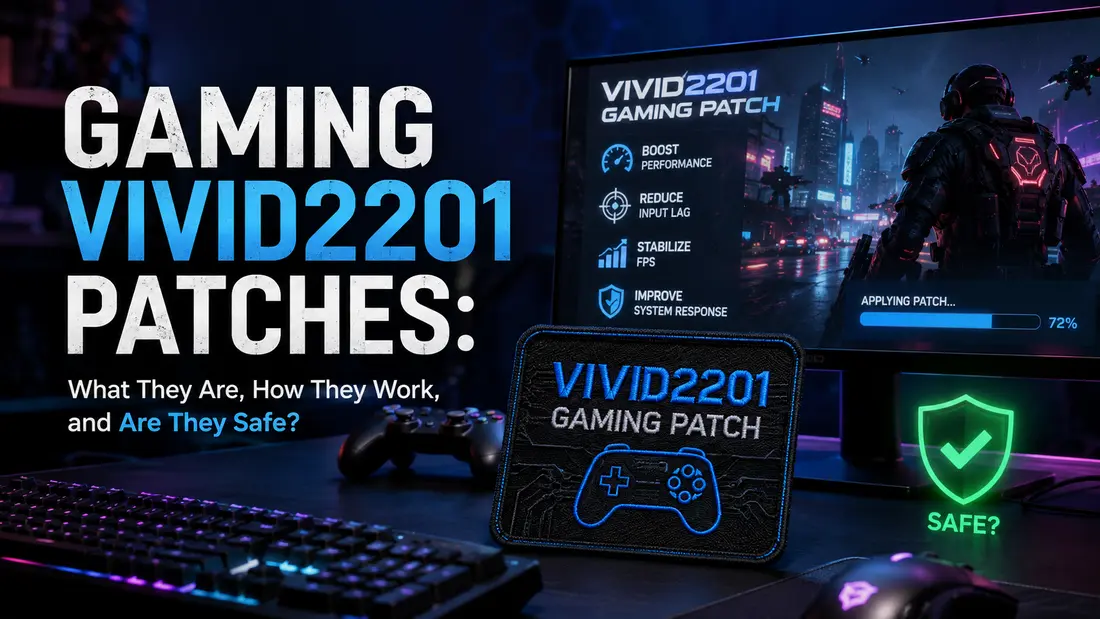
Your PC should be able to handle the game you’re playing. But somehow you’re still watching your frame counter dip during a firefight, or sitting through a five-second stutter every time you load into a new area. That’s usually the moment someone lands on a forum thread or a Reddit comment mentioning “gaming vivid2201 patches” as the fix.
Here’s the thing: the term gets thrown around a lot, but most of what’s written about it skips the most important question — what is this actually, and can you trust it? Let’s break it down properly.
What Are Gaming Vivid2201 Patches, Exactly?
The short answer is that “gaming vivid2201 patches” isn’t an official release from a single game studio or publisher. Based on how the term shows up across gaming forums and tech blogs, it’s better understood as a community label attached to a category of unofficial performance patches — not a specific, verified product with a changelog you can check on an official site.
That distinction matters. When Steam pushes an update, you know exactly who made it, what it changes, and that it went through some form of testing. Vivid2201 patches don’t come with that guarantee. They’re described as configuration tweaks, shader adjustments, and resource-allocation changes shared by modding communities and independent tinkerers, aimed at squeezing more performance out of a game without touching its actual content — no new levels, no new characters, no story changes.
So when you see the term, treat it as shorthand for “unofficial optimization patch,” not as a trademarked tool from a known developer. That framing changes how carefully you should vet a download before you use it.
Why Does the Name “Vivid2201” Keep Showing Up?
This is the question most articles skip entirely. There’s no public record tying “Vivid2201” to a registered studio, a publisher, or a single maintained project. It functions more like a label that got attached to a category of patch files as they circulated across forums and modding communities, similar to how a slang term spreads before anyone agrees on an exact definition.
That doesn’t automatically make it fake or malicious — plenty of legitimate community tools start out this way, with a name that sticks before there’s a formal project behind it. But it does mean you shouldn’t expect a single official homepage, a verified download page, or a support team standing behind the name. Any “Vivid2201 patch” you come across is really just whatever the person sharing it decided to package together.
How Do These Patches Actually Work?
The general idea behind this style of patch is to sit between the game engine and your hardware, adjusting how resources get used instead of rewriting the game itself. A few of the more commonly described mechanisms:
- Memory handling tweaks — reducing memory leaks or reallocating RAM more efficiently during long sessions
- CPU thread distribution — forcing older games (many of which were built before multi-core CPUs were standard) to actually use all your available cores
- Shader and rendering adjustments — precompiling shaders or changing how textures load to cut down on stutter
- GPU-CPU balancing — smoothing out the handoff between your processor and graphics card so one isn’t bottlenecking the other
None of this is exotic. It’s the same category of optimization that a dedicated official patch or a driver update might attempt — the difference is who’s making the change and how much testing it’s been through before it reaches you.
Think of it like adjusting the settings on a car engine rather than replacing the engine itself. Nothing about the game’s actual content changes — no new missions, no new gear, no story beats — but how efficiently your system delivers that content can shift noticeably. On paper, that’s a reasonable goal. In practice, the quality of the result depends entirely on how carefully the specific patch was built, which is exactly why the source matters so much more here than it does with an official update.
What Benefits Do People Report?
If you read through enough discussion threads, a pattern shows up: people report smoother frame pacing, fewer random crashes, and noticeably less stutter, especially on mid-range hardware that was already close to the game’s minimum requirements.
Some of the most commonly cited improvements include:
- More consistent frame delivery instead of just a higher peak FPS number
- Fewer crashes tied to memory mismanagement
- Better performance on older or budget systems without a hardware upgrade
- Reduced texture pop-in and loading hitches in open-world titles
Two things are worth keeping in mind here. First, these are user-reported results, not benchmarked guarantees — your mileage genuinely varies by game, hardware, and which specific patch you’re using. Second, a lot of what these patches “fix” overlaps heavily with what a solid driver update, an in-game settings adjustment, or an official patch would also address. That’s not a reason to dismiss them, but it is a reason to try the free, official options first.
Are Gaming Vivid2201 Patches Safe to Use?
The honest answer is: it depends almost entirely on where you get one.
Because these patches aren’t distributed through an official channel, the file you download is only as trustworthy as the person or community sharing it. A patch sourced from an established modding community with an active user base and visible feedback is a very different risk profile than a random file linked in a random comment section.
Here’s what tends to separate a reasonable risk from a bad one:
Lower risk indicators:
- Shared by a modding community with a track record and visible discussion
- Comes with clear instructions and a way to reverse the changes
- Only modifies configuration files, not core game executables
Red flags to walk away from:
- No information about who made it or how long it’s been circulating
- Requires disabling your antivirus to install
- Bundled with an unrelated installer or “bonus” software
- Promises unrealistic results (“double your FPS instantly”)
If a patch touches protected files in a competitive multiplayer game, there’s also a real chance it triggers anti-cheat detection, even if the intent is purely performance-related. That’s a separate risk from malware — it’s about the game’s terms of service, and it can range from a warning to a ban depending on the title.
How to Approach Installing One Safely
If you decide to go ahead, treat it the same way you’d treat any unofficial software modification — with a healthy dose of caution and a plan B.
- Back up your game files first. Most patches only touch configuration files, but a backup means you can undo everything in minutes if something goes wrong.
- Check the game’s policy on modifications. Single-player and co-op games are generally more forgiving than competitive multiplayer titles.
- Verify the source has a history. A community with years of activity and visible user feedback is safer than an anonymous upload.
- Scan before you run anything. A quick antivirus or malware scan takes seconds and catches the obvious problems.
- Test in a low-stakes session first. Don’t try a new patch right before a ranked match or an important save file — test it somewhere the consequences of a crash are minimal.
None of this guarantees a perfect outcome, but it dramatically lowers the odds of something going wrong.
Common Problems and How to Undo Them
Even a properly installed patch can misbehave. The good news is that most issues trace back to a small set of causes, and most are fixable.
If a game won’t launch after applying a patch, the usual suspects are a corrupted download or a version mismatch between the patch and your current game build. Re-downloading the file or checking that it matches your exact game version solves this more often than not.
If you’re seeing new visual glitches or crashes that weren’t there before, that’s typically a sign the patch conflicts with your specific hardware or driver setup rather than a fundamental flaw in the patch itself.
In either case, the fix is usually the same: restore your backed-up files, or use your platform’s built-in “verify game files” feature (available on Steam and most other major launchers) to reset everything to the original state. That single step resolves the vast majority of patch-related headaches.
Do These Patches Actually Beat Official Optimization?
Not usually, and that’s worth saying plainly. An official patch or a fresh GPU driver update goes through actual testing before release, and it comes with support if something breaks. A community patch doesn’t have either of those safety nets.
Where unofficial patches earn their reputation is in the gap — older games that developers have stopped supporting, or titles where the official optimization simply hasn’t kept pace with newer hardware and operating systems. In that specific situation, a well-regarded community patch can genuinely outperform doing nothing.
But if a game is actively supported and you haven’t already tried updating your graphics drivers, adjusting in-game settings, or checking for a recent official patch, start there. It’s free, it’s tested, and it carries none of the risk that comes with an unofficial file.
Should You Try a Community Patch Instead of Waiting for an Official Fix?
If the developer has already acknowledged the issue and a fix is on the way, waiting is almost always the safer call. Official patches go through internal testing, and installing one doesn’t put your files or your account standing at risk.
The calculation changes for games that are no longer actively updated. If a developer has moved on and a known performance issue is never getting an official fix, a well-reviewed community patch becomes a much more reasonable option — you’re not skipping a better alternative, you’re filling a gap that genuinely won’t get filled otherwise.
Final Thoughts
“Gaming vivid2201 patches” is really just a catch-all term for community-made performance tweaks — not a single verified product, and not something to install without a second thought. When they work, they can genuinely smooth out frame pacing and stability on hardware that’s struggling to keep up. When they go wrong, it’s almost always because of where the file came from, not because the underlying idea was bad.
Start with the official route: driver updates, in-game settings, and any real patches from the developer. If you still want to try a community optimization patch after that, stick to established sources, back up your files, and test before you commit. That’s the difference between a smoother gaming session and a weekend spent troubleshooting.
Have you tried an unofficial performance patch before? Share what worked (or didn’t) for your setup in the comments.