

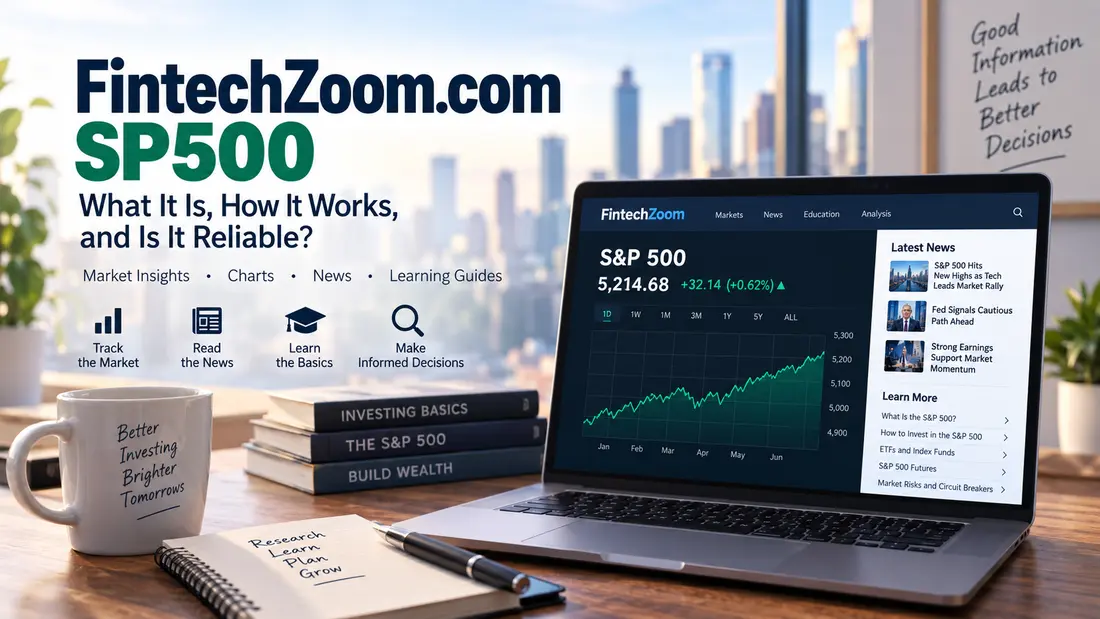
If you’re looking for fintechzoom.com sp500, you’re probably trying to check the S&P 500, read the latest market news, or understand why the index is moving. FintechZoom’s dedicated page brings together market tracking, charts, commentary, and investing guides in one place. But there’s a detail worth keeping straight: FintechZoom provides market information, while the S&P 500 itself is maintained by S&P Dow Jones Indices. So, what does the page actually offer, where does its data come from, and how much should you trust it? Let’s take a closer look.
What Does “fintechzoom.com sp500” Mean?
The phrase fintechzoom.com sp500 refers to FintechZoom’s dedicated S&P 500 page. Think of it as a starting point for checking the market, reading related news, and learning how one of the world’s most watched stock indexes works.
The page brings together several useful features, including index tracking, interactive charts, market commentary, and educational guides. If you want to see how the S&P 500 is performing or understand what might be driving a move, these tools can give you a quick overview without making you jump between several pages.
People also use the page to learn about ETFs, S&P 500 futures, index funds, and basic market concepts. That makes it useful for both beginners and readers who simply want a quick market update.
Still, there’s an important distinction. FintechZoom is not the official provider of the S&P 500, and it is not a brokerage where you can directly buy the index. It is an information and research resource. For official index details or tradable investment products, you’ll need to look elsewhere.
What Is the S&P 500? A Simple Explanation
If you’ve ever heard someone say, “The market is up today,” they may be talking about the S&P 500. It is one of the most widely followed stock market indexes, and it gives investors a quick way to gauge how many of the biggest U.S. companies are performing.
The S&P 500 tracks large U.S. companies
The S&P 500, short for Standard & Poor’s 500 Index, tracks 500 large companies listed on U.S. stock exchanges. These businesses come from a wide range of industries, including technology, healthcare, finance, and consumer goods. Together, they represent roughly 80% of the available U.S. stock market value, according to the supplied research. That broad coverage is why the index is often used as a snapshot of the large-cap U.S. stock market.
Why market capitalization matters
The S&P 500 is market-capitalization weighted, which means larger companies have more influence on its movement. For example, a sharp rise in a mega-cap technology company can move the index more than a similar rise in a smaller company. This also explains why the S&P 500 can finish the day higher even when plenty of its individual stocks are falling.
Who maintains the index?
The S&P 500 is maintained by S&P Dow Jones Indices, which sets its methodology and manages decisions about its constituents. FintechZoom presents information about the index, but it does not create or administer it. That distinction matters when you need to compare a market update with official index details.
What Does FintechZoom Show for the S&P 500?
FintechZoom’s S&P 500 page is designed to give readers a quick view of what is happening in the market. Instead of offering just a single index number, it brings together charts, news, and educational material that can help put daily movements into context.
Index tracking and interactive charts
The page includes market tracking tools and interactive charts. The supplied research identifies Stockdio widgets and TradingView charts as part of the page’s data and chart experience. Readers can use these tools to review index movement, look at price trends, and get a sense of the market’s direction. One thing to keep in mind is that the figures you see may depend on the data provider, update schedule, and whether the information is live or delayed.
Market news and commentary
The page also brings together news and commentary about the S&P 500. Topics may include record highs, market volatility, Federal Reserve decisions, company earnings, and sector performance. This can be useful when you see the index move sharply and want to understand the story behind it. Still, a headline or forecast is only one view of the market. It should not be treated as a promise about what happens next.
Educational guides and investing basics
For readers who are still learning, FintechZoom also covers topics such as index funds, ETFs, the Vanguard S&P 500 ETF, S&P 500 futures, and circuit breakers. It may also include guides on how to invest in the S&P 500. These resources can help explain how different products work, but learning about an ETF or futures contract is not the same as buying one. Each product has its own costs, risks, and trading rules.
Where Does FintechZoom’s S&P 500 Data Come From?
When you check a market page, it is easy to assume the website itself creates every number you see. That is not usually how financial information works. Many platforms collect data from outside providers and present it through their own charts, tools, and articles.
FintechZoom does not maintain the S&P 500 index itself. Based on the supplied research, its S&P 500 page uses third-party integrations, including Stockdio for market data widgets and TradingView for interactive charts. These tools help display market figures and price movements, while FintechZoom brings the information together with news and educational content.
That makes FintechZoom an information aggregator, rather than the primary source responsible for the index.
This distinction is worth remembering when you check a number. Is the figure live or delayed? What date and time does it represent? Which provider supplied it? And does the chart show the S&P 500 index, an ETF that tracks it, or another related product? Those details can change how you interpret what you see.
For a quick market overview, this setup can be useful. For an important investment decision, it is better to confirm the figure through an official or primary source.
Is FintechZoom’s S&P 500 Information Reliable?
The short answer is that FintechZoom can be useful, but it should not be your only source of market information. Its value depends on what you need and how carefully you check the details.
What FintechZoom is useful for
FintechZoom can be a convenient place to check whether the S&P 500 is rising or falling, read market headlines, and get a general sense of what is moving investor attention. Its educational material may also help beginners understand index funds, ETFs, futures, and other market concepts.
Another useful role is topic discovery. You might read about a sharp market move and decide to look further into interest rates, company earnings, sector performance, or the influence of large technology stocks. In that sense, the platform can serve as a starting point for learning and further research.
These are practical uses for market awareness. They do not require the platform to replace a professional data terminal or official index documentation.
Where readers should be cautious
The supplied research points to several limits. FintechZoom is not the official S&P 500 provider, and there may be limited transparency around exact data sources, update frequency, and delay policies. Its commentary may explain what happened in the market without offering the kind of original analysis found in specialist research platforms.
Readers should also consider how much information is available about an article’s author, editorial process, and supporting evidence. A market forecast can be interesting, but it remains an opinion, not a promise.
FintechZoom’s content is intended for general educational and informational purposes, not investment advice. That means important prices, index details, and investment claims deserve a second check.
The practical verdict
FintechZoom is a useful starting point for market awareness and basic learning. However, readers should verify important figures and investment claims through official or primary sources before making financial decisions. Treat it as one research tool, not the final word.
How to Use FintechZoom.com SP500 Safely
FintechZoom can be useful when you want a quick view of the S&P 500, but it works best as a starting point rather than your only source of market information. A few simple habits can help you use the page with more confidence.
1. Use It for an Overview
Start by checking the index level and the general direction of the market. Is the S&P 500 rising, falling, or moving sideways? You can also read related headlines to understand what may be driving the move. Use these details to find topics worth researching further.
2. Verify Important Figures
When a number matters, compare it with information from S&P Dow Jones Indices, a brokerage platform, or a trusted financial data provider. This is especially useful when checking prices, percentage changes, historical levels, or market statistics.
3. Separate Facts from Forecasts
A prediction about where the index may go is not a promise. Treat forecasts as opinions, even when they sound confident. Check the date, author, and evidence behind the prediction before giving it much weight.
4. Check the Date and Author
Market information can become outdated quickly. Search engines may also show older articles that no longer match current conditions. Always confirm when an article was published and whether its claims still apply.
5. Understand the Product You Are Researching
You generally cannot buy the S&P 500 index directly. Most investors access it through ETFs or index funds. Futures, options, and leveraged products work differently and can carry much greater risk.
6. Remember That Diversification Does Not Remove Risk
The S&P 500 spreads exposure across many large companies, which helps reduce the risk tied to one stock. However, it can still fall during a market-wide decline or bear market. Diversification reduces certain risks, but it does not remove market risk.
FintechZoom vs. Official S&P 500 Sources
Different sources serve different purposes, so there is no need to rely on one website for every market-related task. FintechZoom may be useful for getting a quick overview, reading market news, viewing charts, and learning basic investing concepts. However, it is not the official provider of the S&P 500.
| Source | Best for | Main limitation |
|---|---|---|
| FintechZoom | Market awareness, charts, news, and beginner education | Not the official index provider |
| S&P Dow Jones Indices | Official index information, methodology, and company details | May be less beginner-friendly |
| Investor.gov | General investing education and risk guidance | Not designed as a live market dashboard |
| Brokerage platform | Tradable quotes and investment access | Features and data depend on the broker |
| Reputable financial data provider | Detailed market analysis and historical data | Some tools may require payment |
For official S&P 500 data, index methodology, and information about its constituents, S&P Dow Jones Indices is the stronger source. Investor.gov is more useful when you need clear guidance about investing risks and basic market concepts.
A brokerage platform is better suited to checking tradable products, live or delayed quotes, and order information. Financial data providers may offer deeper historical records and advanced analysis.
The best approach is to match the source to the decision you are making. Use FintechZoom for discovery and context, then confirm important figures and claims through a more direct source.
Final Thoughts
For readers searching fintechzoom.com sp500, the page can be a useful starting point for checking market information, reading S&P 500 news, and learning how the index works. Its value is strongest when used alongside official index information, trusted financial data, and a reliable brokerage platform. Remember that FintechZoom is not the official index provider, and its forecasts should not be treated as promises. Check dates, verify important numbers, and make decisions based on more than one source.
Read Also: 10 Other Sites Like Tomoson to Try in 2026