

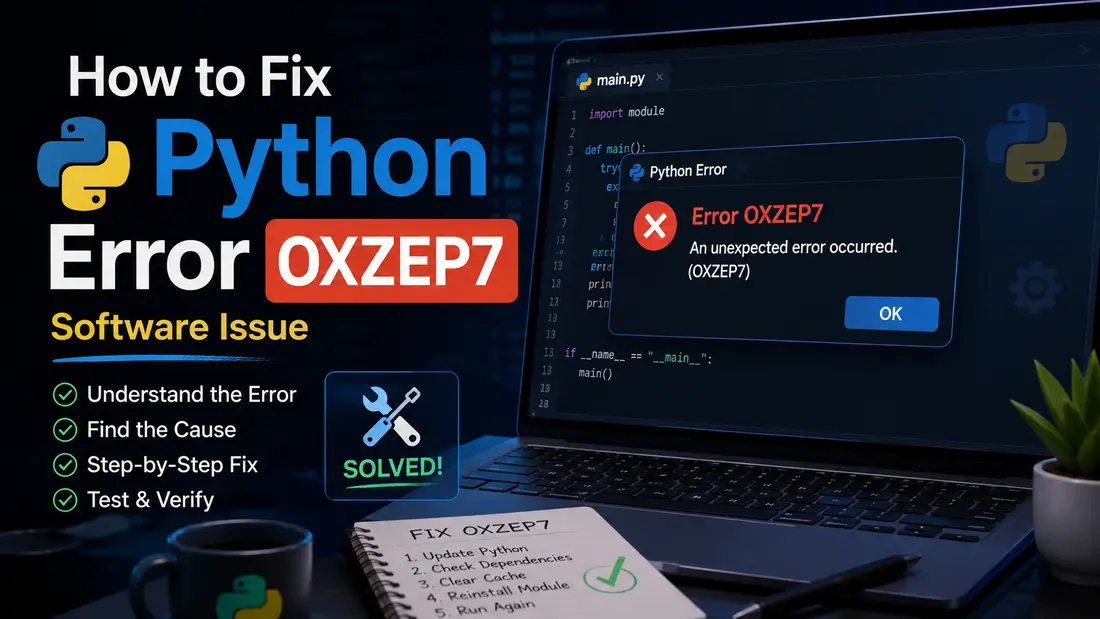
You’re mid-task, your script or app throws a dialog box you’ve never seen before, and it just says “OXZEP7.” No explanation, no obvious next step, just a code that means nothing to you and a search bar that isn’t giving you a straight answer.
Here’s the good news: this isn’t some obscure system failure that needs a specialist. It’s almost always a Python environment problem wearing a confusing label. Once you know what’s actually going on behind that code, fixing it takes minutes, not hours.
What Does the OXZEP7 Error Actually Mean?
First, the important context: OXZEP7 is not a built-in Python interpreter error. If you search Python’s official documentation or exception hierarchy, you won’t find it listed anywhere, because it isn’t part of the language itself.
What you’re looking at is a custom error identifier generated by a specific application that happens to be built on Python. Instead of showing you a raw traceback full of file paths and line numbers, the developers wrapped that failure in a simpler, branded code. That’s a deliberate design choice, not a bug in Python.
Why Do Developers Use Codes Like This Instead of Real Tracebacks?
Raw Python tracebacks are useful for developers, but they’re intimidating for everyone else. A stack trace full of internal file references doesn’t tell an average user anything actionable — it just looks broken.
So many applications catch the underlying exception internally and replace it with a short, memorable code tied to an internal support article or log entry. It’s meant to simplify troubleshooting, even though in practice it often does the opposite when that support documentation is thin or hard to find.
Is OXZEP7 the Same on Every Computer?
Not necessarily. Because this code comes from the application layer rather than Python itself, how it behaves can shift slightly depending on your operating system and how the app was packaged for it.
On Windows, it’s most often tied to installation paths, registry entries, or a Python install that isn’t registered correctly with the system. On Mac and Linux, the same underlying causes show up, but the fixes usually route through package managers like brew or apt instead of a Windows-style installer, and PATH issues tend to involve shell configuration files like .bashrc or .zshrc rather than system environment variable settings.
What Typically Causes It?
Once you strip away the branding, the OXZEP7 error behaves like most Python environment failures. It almost always traces back to one of four root causes.
A Corrupted or Incomplete Installation
If Python itself was interrupted during install, or files were partially removed during an update, the application built on top of it can fail to initialize correctly. This is one of the most common triggers, especially after a forced shutdown mid-installation.
Missing or Mismatched Dependencies
Python applications typically rely on several external packages working together at specific, compatible versions. If one dependency is missing, outdated, or conflicts with another package’s required version, the app can throw an error the moment it tries to import that module.
Broken Environment Variables or PATH Issues
Your system needs to know exactly where Python lives to run it correctly. If the PATH variable is misconfigured, missing the Python directory, or pointing to the wrong install location, applications built on Python may fail before they even get started.
Conflicting Python Versions
Having multiple Python versions installed side by side is common, especially for anyone who’s worked on different projects over time. The problem comes when an application defaults to the wrong version, or when a package installed for one version isn’t available to another.
For example, if you’ve got Python 3.9 and Python 3.12 both installed, and a dependency was only ever installed under 3.9, an application that launches using 3.12 by default will fail to find it — even though, from your perspective, “the package is definitely installed.” This mismatch is one of the most common sources of confusion, because the error message rarely tells you which Python version it’s actually running under.
Insufficient Permissions
It’s worth calling out as a fifth, less common cause: some installations and package updates need elevated permissions to write to certain system directories. If the application or a dependency install was blocked partway through because of a permissions restriction, the result can look identical to a corrupted installation, even though the underlying cause and fix are different. Running the installer or terminal command as an administrator (Windows) or with sudo (Mac/Linux) resolves this specific case — though it’s worth trying only after ruling out the more common causes above, since defaulting to elevated permissions for everything can mask other problems.
How Do I Find Out What’s Actually Behind This Error?
Before applying any fix, it’s worth spending two minutes identifying which of the four causes above you’re actually dealing with. Guessing wastes time; a quick diagnostic step saves it.
Start by running the application from a terminal or command prompt instead of double-clicking it. Many apps suppress the full error output in their normal interface but print the real underlying Python traceback when launched from the command line.
If that’s not available, check for a log file. Most Python-based applications write a log somewhere in their installation directory or in your system’s application data folder, and that log usually contains the real exception name buried beneath the friendly OXZEP7 label. Look for lines mentioning ModuleNotFoundError, ImportError, or PermissionError — these tell you exactly which cause you’re facing, and which fix below to jump to first.
Does Running as Administrator Always Fix It?
Not always, and it’s worth understanding why before you reach for it as a default habit. Running as administrator only helps if the root cause is a permissions restriction. If the real issue is a missing dependency or a version conflict, elevated permissions won’t touch either of those — you’ll just be back at the same error with an extra step added to your routine. Use the diagnostic step above to confirm what you’re actually dealing with before deciding whether this is the right move.
Step-by-Step Fixes
Once you’ve narrowed things down, work through these fixes in order. Even if you’re not sure which cause applies, this sequence resolves the vast majority of OXZEP7-style errors.
Verify Your Python Installation
Open your terminal or command prompt and type python --version. If nothing returns, or you get an error instead of a version number, your Python installation itself is the problem. Reinstall it from the official source and make sure to check the box that adds Python to your system PATH during setup.
Repair or Reinstall the Affected Application
If Python itself checks out fine, the issue is likely with the specific application. On Windows, open Control Panel, find the software in your installed programs list, and choose the repair option if one’s available. If not, a clean uninstall followed by a fresh install usually clears out whatever got corrupted.
Reinstall Dependencies
If your diagnostic step pointed to a missing or broken module, reinstall it directly. Run pip install --force-reinstall followed by the package name to overwrite a potentially corrupted copy. If the application ships with a requirements file, running pip install -r requirements.txt reinstalls everything it needs in one pass.
Fix Your PATH and Environment Variables
Check that your system PATH includes the correct Python installation directory. On Windows, this typically looks something like C:\Users\YourUser\AppData\Local\Programs\Python\Python312. On Mac or Linux, running which python3 in your terminal confirms exactly which installation your system is defaulting to.
Resolve Version Conflicts With a Virtual Environment
If you’ve got multiple Python versions or projects with conflicting dependency requirements, stop trying to manage them all in one global environment. Create a virtual environment specific to the application giving you trouble, activate it, and install only the dependencies that application needs. This isolates it completely from whatever else is installed on your system.
If Nothing Above Works
Occasionally, none of these five fixes resolve the error on the first pass — usually because more than one cause is stacked on top of the other. If that’s where you’ve landed, work through the list a second time in order: start with a clean Python reinstall, then the application repair, then dependencies, then PATH, then a virtual environment. Doing them in that sequence eliminates variables one at a time instead of changing several things at once, which makes it much easier to tell what actually fixed it if the error disappears partway through.
If it still persists after a full pass, the error log you pulled earlier becomes essential — at that point, searching for the exact underlying exception name (not just “OXZEP7”) will get you far more specific, useful results.
Is This Error a Sign of Malware or a Security Risk?
Reasonably, this is one of the first questions people ask when they see an unfamiliar error code — and the answer is reassuring. On its own, OXZEP7 is a software configuration issue, not a symptom of malicious activity. It’s the same category of problem as a missing DLL file or an outdated dependency, nothing more sinister.
That said, context matters. If this error started appearing right after installing software from an unofficial or unverified source, it’s worth running a quick antivirus scan just to rule that out. The error itself isn’t the red flag — where the software came from is.
How to Prevent It From Happening Again
Fixing the error once is good. Not seeing it again is better.
The single most effective habit here is using a dedicated virtual environment for every Python project or application you work with. It keeps dependencies isolated, so an update or install for one project can’t quietly break another.
Beyond that, pin your dependency versions explicitly rather than always installing the latest release. A requirements.txt file with exact version numbers means you’re never caught off guard by an update that silently breaks compatibility with something else you’re running.
Keep Python itself updated to a current stable version, and avoid letting installations sit half-finished if a setup process gets interrupted — always let it complete or roll it back cleanly rather than leaving things in a partial state. If you’re regularly switching between projects with different requirements, get comfortable with a version manager (like pyenv on Mac/Linux) rather than manually juggling multiple global installs. It’s a small setup cost upfront that saves a lot of repeat troubleshooting later.
Finally, if you’re installing software that runs on Python from outside the usual official channels, take the extra minute to confirm it’s from a source you trust. Most OXZEP7-style errors are harmless configuration issues, but the fastest way to end up with a genuinely serious problem is skipping that check on unfamiliar software.
Conclusion
The OXZEP7 error looks intimidating mostly because it doesn’t explain itself. Underneath that unfamiliar code is a very ordinary Python environment issue — a corrupted install, a missing dependency, a PATH misconfiguration, or a version conflict.
Work through the diagnostic step first so you’re not fixing things blind, then apply the matching solution from the list above. In most cases, you’ll be back up and running well within the hour.
Ran into a different variation of this error, or found a fix that isn’t listed here? Drop it in the comments — it helps the next person land on this page with the same problem.
Read Also: Is 2579xao6 Easy to Learn? Here’s Why That’s the Wrong Question